

 raitechcorporation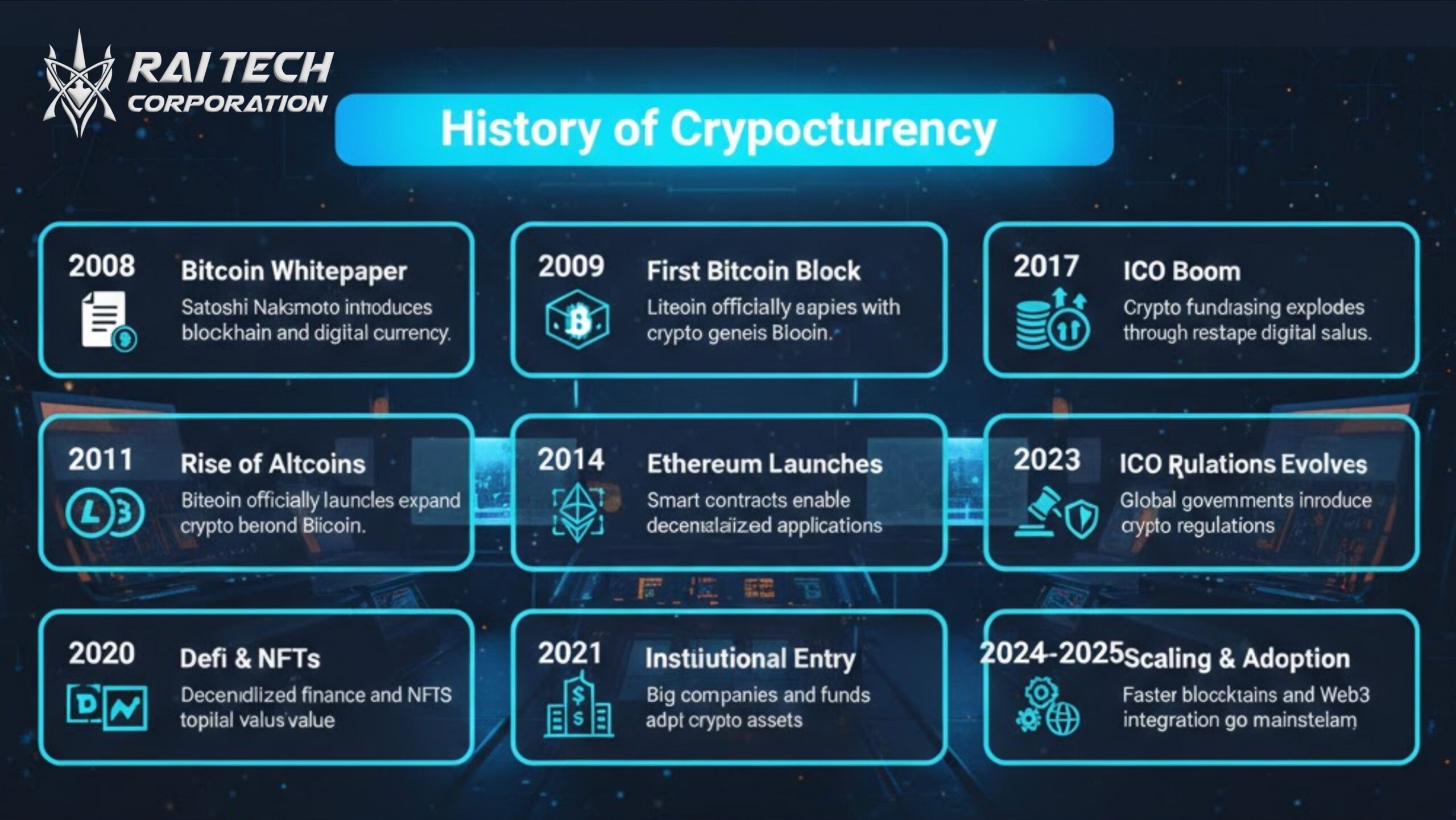
The history of cryptocurrency is a remarkable journey that has transformed the global financial system. From the release of the Bitcoin whitepaper in 2008 to the rise of decentralized finance (DeFi), NFTs, and Web3 ecosystems, cryptocurrencies have evolved from an experimental idea into a powerful technological revolution. At Rai Tech Corporation, we specialize in blockchain development solutions that help businesses build and scale innovative crypto and Web3 platforms.
This blog explores the complete timeline of cryptocurrency evolution and how blockchain technology continues to reshape industries worldwide.
2008 – Bitcoin Whitepaper: The Birth of Cryptocurrency
The foundation of cryptocurrency was laid in 2008 when Satoshi Nakamoto published the Bitcoin whitepaper titled “Bitcoin: A Peer-to-Peer Electronic Cash System.” This document introduced blockchain technology and proposed a decentralized digital currency that operates without banks or intermediaries.
Bitcoin solved the double-spending problem using cryptographic proof and distributed consensus, marking the beginning of trustless financial systems.
2009 – First Bitcoin Block (Genesis Block)
In 2009, Bitcoin officially launched with the mining of the Genesis Block. This event marked the first real-world implementation of blockchain technology. Bitcoin introduced secure peer-to-peer transactions, decentralized mining, and immutable ledgers—core principles that remain central to cryptocurrencies today.
2011 – Rise of Altcoins
As Bitcoin gained attention, alternative cryptocurrencies, known as altcoins, began to emerge. Projects like Litecoin introduced faster transactions and improved scalability. This era proved that blockchain technology could be adapted and customized beyond Bitcoin’s original framework.
2015 – Ethereum Launches Smart Contracts
Ethereum changed the crypto industry forever by introducing smart contracts—self-executing programs that run on the blockchain. This innovation enabled the development of decentralized applications (dApps), decentralized exchanges, NFT platforms, and DAO ecosystems.
Ethereum became the backbone of modern blockchain development and Web3 innovation.
2017 – ICO Boom and Crypto Fundraising
The year 2017 saw massive growth in cryptocurrency adoption through Initial Coin Offerings (ICOs). Startups raised billions of dollars by launching their own tokens, fueling innovation in blockchain startups, wallets, exchanges, and payment platforms.
This phase highlighted both the potential and risks of crypto investments, pushing the industry toward better regulation and transparency.
2020 – DeFi and NFTs Reshape Digital Ownership
Decentralized Finance (DeFi) and Non-Fungible Tokens (NFTs) became mainstream in 2020. DeFi platforms enabled lending, borrowing, and trading without intermediaries, while NFTs introduced verifiable digital ownership for art, gaming, and virtual assets.
Blockchain technology expanded beyond finance into entertainment, gaming, real estate, and digital identity.
2021 – Institutional Adoption of Cryptocurrency
Major corporations, investment funds, and financial institutions entered the crypto market in 2021. Companies began accepting Bitcoin as payment, launching crypto funds, and investing in blockchain infrastructure.
Institutional adoption validated cryptocurrency as a legitimate asset class and accelerated global adoption.
2023 – Crypto Regulations Evolve Worldwide
As cryptocurrency adoption increased, governments worldwide introduced clearer crypto regulations. Regulatory frameworks focused on investor protection, compliance, and financial stability while encouraging innovation in blockchain technology.
This phase strengthened trust and paved the way for enterprise blockchain solutions.
2024–2025 – Scaling, Web3, and Mass Adoption
The current era focuses on scalability, interoperability, and Web3 integration. Faster blockchains, Layer-2 solutions, DAOs, and decentralized governance models are driving mass adoption across industries.
Cryptocurrency is now a core component of digital finance, enterprise systems, and decentralized ecosystems.
How Rai Tech Corporation Supports Blockchain & Crypto Innovation
At Rai Tech Corporation, we provide end-to-end blockchain development services to help businesses leverage cryptocurrency technology effectively. Our services include:
Blockchain development solutions
Cryptocurrency and token development
Smart contract development and auditing
DeFi, NFT, and DAO platform development
Web3 and decentralized application (dApp) development
We help startups, enterprises, and innovators build secure, scalable, and future-ready blockchain platforms.
Why Cryptocurrency Matters for the Future
Cryptocurrency represents more than digital money—it is a shift toward decentralization, transparency, and user empowerment. As blockchain technology continues to evolve, cryptocurrencies will play a critical role in shaping finance, governance, and digital economies.
Businesses that adopt blockchain today gain a competitive edge in the decentralized future.
Conclusion
The history of cryptocurrency reflects the rapid evolution of blockchain technology from Bitcoin’s inception to the rise of Web3 ecosystems. As adoption grows, innovation continues to unlock new possibilities across industries. With expert blockchain development services, Rai Tech Corporation helps businesses stay ahead in the crypto revolution.
📞 Contact Rai Tech Corporation
Website: https://www.raitechcorporation.com
Phone: +91 6394882355
Email: raitechcorporation@gmail.com